Follow along with Doris & Marc as they tour some of Oregon's beautiful Covered Bridges. |
(Click
on the small pictures to view enlargements) Click on Video Icon  to view related videos. to view related videos. |
Please wait, Background loading BACK TO Marc & Doris' HOME PAGE
Follow along with Doris & Marc as they tour some of Oregon's beautiful Covered Bridges. |
| (Click
on the small pictures to view enlargements) Click on Video Icon to view related videos. |
After visiting the Oregon coast
on several day trips, (as you may have already seen on our home page), Marc & I wanted
to explore other parts of the state, especially Crater Lake National Park. Our
challenge was to devise a memorable tour within a reasonable budget. Our ultimate decision
was to make a four-day trip into a mini-vacation. We believe, as our best friend John
Franich does, that camping is hotel accommodations without room service. So within these
guidelines we planned ahead and booked three nights in reasonably priced motels.
Packing a cooler to take care of our basic needs, we hit the road early on Saturday
morning.  Part
of our plan was to include continental breakfast at our lodging as part of our travel
expenses, limiting ourselves to one meal out in the evening. We have learned through
trial and error to pack our own coffee and all the fixings as most hotels provide a coffee
maker, but little else. Also, bringing your own coffee travel mugs will insure frequent
free refills during your trip. We left Des Moines, WA at 6:00am on a cloudy &
cool morning, and traveled down I-5 southbound targeting Cottage Grove, OR as our first
stopover. We bypassed Portland taking I-205 and arrived in Central Oregon in plenty of
time to visit a handful of covered bridges before check-in time at our hotel. Armed with
brochures and chamber of commerce information regarding the covered bridges of Oregon, we
began our "treasure hunt" in Marion
Part
of our plan was to include continental breakfast at our lodging as part of our travel
expenses, limiting ourselves to one meal out in the evening. We have learned through
trial and error to pack our own coffee and all the fixings as most hotels provide a coffee
maker, but little else. Also, bringing your own coffee travel mugs will insure frequent
free refills during your trip. We left Des Moines, WA at 6:00am on a cloudy &
cool morning, and traveled down I-5 southbound targeting Cottage Grove, OR as our first
stopover. We bypassed Portland taking I-205 and arrived in Central Oregon in plenty of
time to visit a handful of covered bridges before check-in time at our hotel. Armed with
brochures and chamber of commerce information regarding the covered bridges of Oregon, we
began our "treasure hunt" in Marion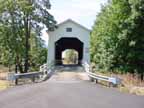 County searching for the Gallon House covered bridge, near the township of
Mt. Angel. Having only a sketchy idea of where this bridge was located, we were rescued by
the manager of the local NAPA auto parts store who drew us a very interesting map which
got us there within ten minutes
(Driving
directions). (Not bad for never having been in the area before.)
The Gallon House Bridge is the oldest covered bridge in Oregon. It was named during the
days when liquor was sold by the gallon or quart in a nearby house. The bridge was rebuilt
in 1990. From here we retraced our steps to I-5 and headed south (Driving Directions) in search of the Parvin Covered Bridge
in Dexter, OR.
County searching for the Gallon House covered bridge, near the township of
Mt. Angel. Having only a sketchy idea of where this bridge was located, we were rescued by
the manager of the local NAPA auto parts store who drew us a very interesting map which
got us there within ten minutes
(Driving
directions). (Not bad for never having been in the area before.)
The Gallon House Bridge is the oldest covered bridge in Oregon. It was named during the
days when liquor was sold by the gallon or quart in a nearby house. The bridge was rebuilt
in 1990. From here we retraced our steps to I-5 and headed south (Driving Directions) in search of the Parvin Covered Bridge
in Dexter, OR. 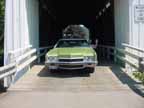 J
The Parvin Bridge
spans Lost Creek. It is 75 feet in length, built in 1921, and is open to automobile
traffic. Named for a pioneer family, the Parvin Bridge replaced an earlier roofed bridge
erected in the 1880's. It was restored in 1986. Next we headed off in search of the Lowell
Bridge the widest of all the covered bridges. It is also the only known instance of a
covered bridge over a reservoir. To get there from the Parvin Bridge we got back onto
State Route 58 heading east. (Driving Directions)
J
The Parvin Bridge
spans Lost Creek. It is 75 feet in length, built in 1921, and is open to automobile
traffic. Named for a pioneer family, the Parvin Bridge replaced an earlier roofed bridge
erected in the 1880's. It was restored in 1986. Next we headed off in search of the Lowell
Bridge the widest of all the covered bridges. It is also the only known instance of a
covered bridge over a reservoir. To get there from the Parvin Bridge we got back onto
State Route 58 heading east. (Driving Directions) 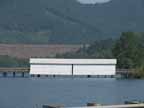 This bridge replaced a 1907 covered span. It crosses the
middle fork of the Willamette River and is 165 feet long. It was built in 1945 and is 24
feet wide. This bridge handled heavy logging truck traffic until it was closed to all
traffic crossing in 1981. We continued across the reservoir, heading north, looking for
the Unity Bridge. Taking
the Jasper Lowell Road for 2 1/2 miles we arrived at our destination.
This bridge replaced a 1907 covered span. It crosses the
middle fork of the Willamette River and is 165 feet long. It was built in 1945 and is 24
feet wide. This bridge handled heavy logging truck traffic until it was closed to all
traffic crossing in 1981. We continued across the reservoir, heading north, looking for
the Unity Bridge. Taking
the Jasper Lowell Road for 2 1/2 miles we arrived at our destination. 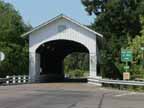 The
bridge crosses Fall Creek, is 90 feet long, was built in 1936 and is open to automobile crossing. At this point we
decided to call it a day and head down to Cottage Grove and check into our motel for the
night. As we passed through Lowell this little guy caught our eye and we just had to take
his picture. We are sure that this is by far the smallest covered bridge in Oregon. It is
only open to pedestrian traffic as it is on a sidewalk.
The
bridge crosses Fall Creek, is 90 feet long, was built in 1936 and is open to automobile crossing. At this point we
decided to call it a day and head down to Cottage Grove and check into our motel for the
night. As we passed through Lowell this little guy caught our eye and we just had to take
his picture. We are sure that this is by far the smallest covered bridge in Oregon. It is
only open to pedestrian traffic as it is on a sidewalk. 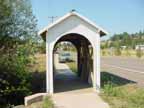 Too funny. We
reached the Comfort Inn in Cottage Grove after only a short time on the road, checked in
around 5:00pm and had time to go swimming in the pool before sunset. After a good night's
rest, we started out the next morning with a quick continental breakfast supplied by the
Comfort Inn & began our search for the 5 covered bridges located in Cottage Grove. The
Centennial Bridge was the first bridge we visited & being located in the downtown
Cottage Grove area proved very easy to find. Cottage Grove has taken the time to provide
directional
Too funny. We
reached the Comfort Inn in Cottage Grove after only a short time on the road, checked in
around 5:00pm and had time to go swimming in the pool before sunset. After a good night's
rest, we started out the next morning with a quick continental breakfast supplied by the
Comfort Inn & began our search for the 5 covered bridges located in Cottage Grove. The
Centennial Bridge was the first bridge we visited & being located in the downtown
Cottage Grove area proved very easy to find. Cottage Grove has taken the time to provide
directional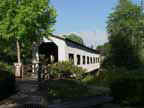 signs for an easy
to follow self-tour. This bridge is 84 feet long &
was built in 1987 & is open to pedestrian crossing only, it was completed for Cottage
Grove's 100th anniversary. On this sunny day, temperatures in the 60's with clear
skies and only a calm breeze,
signs for an easy
to follow self-tour. This bridge is 84 feet long &
was built in 1987 & is open to pedestrian crossing only, it was completed for Cottage
Grove's 100th anniversary. On this sunny day, temperatures in the 60's with clear
skies and only a calm breeze, 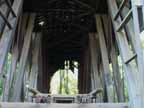 we
traveled further on to the Chambers Railroad Bridge. This rustic structure was used by
trains to bring in logs to a local mill. The trains stopped running in 1943 when the mill
burned. Our next stop was the Currin Bridge over the Row River.
we
traveled further on to the Chambers Railroad Bridge. This rustic structure was used by
trains to bring in logs to a local mill. The trains stopped running in 1943 when the mill
burned. Our next stop was the Currin Bridge over the Row River.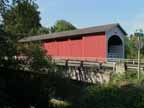 It was built in 1925, it's 105 feet long and is open to
pedestrian crossing.
Closed to crossing
in 1979, this bridge was restored in 1995. Off to find Lane County's oldest covered
bridge, we set our sights on Mosby Creek.
It was built in 1925, it's 105 feet long and is open to
pedestrian crossing.
Closed to crossing
in 1979, this bridge was restored in 1995. Off to find Lane County's oldest covered
bridge, we set our sights on Mosby Creek. 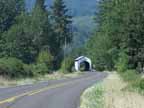 In 1990 it was restored to handle heavier crossing, it is 90
feet long and was built in 1920. The last bridge we visited in the Cottage Grove area was
the Stewart Bridge which was built in 1930. It is 60 feet long & in 1987 restoration
allowed pedestrian & bicycle crossing.
In 1990 it was restored to handle heavier crossing, it is 90
feet long and was built in 1920. The last bridge we visited in the Cottage Grove area was
the Stewart Bridge which was built in 1930. It is 60 feet long & in 1987 restoration
allowed pedestrian & bicycle crossing. 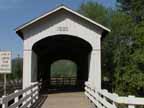 The
bridge was by-passed in the 1980's by a concrete bridge. Steps lead down to the Mosby
Creek below for fishing & swimming. Before we take you along on the next leg of our
adventure, we would like to include our visit to Short Bridge, which we discovered
the following day. Here are the details; the Short Bridge crosses the South Santiam River,
The
bridge was by-passed in the 1980's by a concrete bridge. Steps lead down to the Mosby
Creek below for fishing & swimming. Before we take you along on the next leg of our
adventure, we would like to include our visit to Short Bridge, which we discovered
the following day. Here are the details; the Short Bridge crosses the South Santiam River,
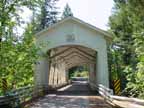 it
was built in 1945 & is 105 feet long. Named for a local resident, the Short Bridge is
the sole survivor of the covered bridges which crossed the South Fork of the Santiam
River. Visitors to this bridge quite often see deer and other animals nearby. Our
Adventure to Crater Lake National Park is next...
it
was built in 1945 & is 105 feet long. Named for a local resident, the Short Bridge is
the sole survivor of the covered bridges which crossed the South Fork of the Santiam
River. Visitors to this bridge quite often see deer and other animals nearby. Our
Adventure to Crater Lake National Park is next...